Ask any business owner where they rank on Maps. They will pull out a phone, run the search, and show you a number.
That number is their rank on that corner. Two streets over, it is another one. Across the avenue, another one still.
A local rank is not a number. It is a map of numbers, and a tool exists that draws that map.
How the map gets drawn
The tool is called Local Falcon, and what it does is easy to describe. It builds a grid of geographic points around the business. Then it runs the same search at every point, as if a person were standing on each corner. 1
A 7 by 7 grid means 49 separate checks. Every colored pin on the map is the rank of the business as seen from that point. This is called a grid scan.
Our own scan, published
We ran the scan on the SEO Genome Business Profile on September 1, 2026, for the Portuguese term “agência de SEO” (SEO agency). A 7 by 7 grid, radius of 1 km, 0.33 km between pins, in Alto do Ipiranga, a neighborhood in São Paulo, Brazil. 2
The result is not pretty, and it goes out exactly as it came back.
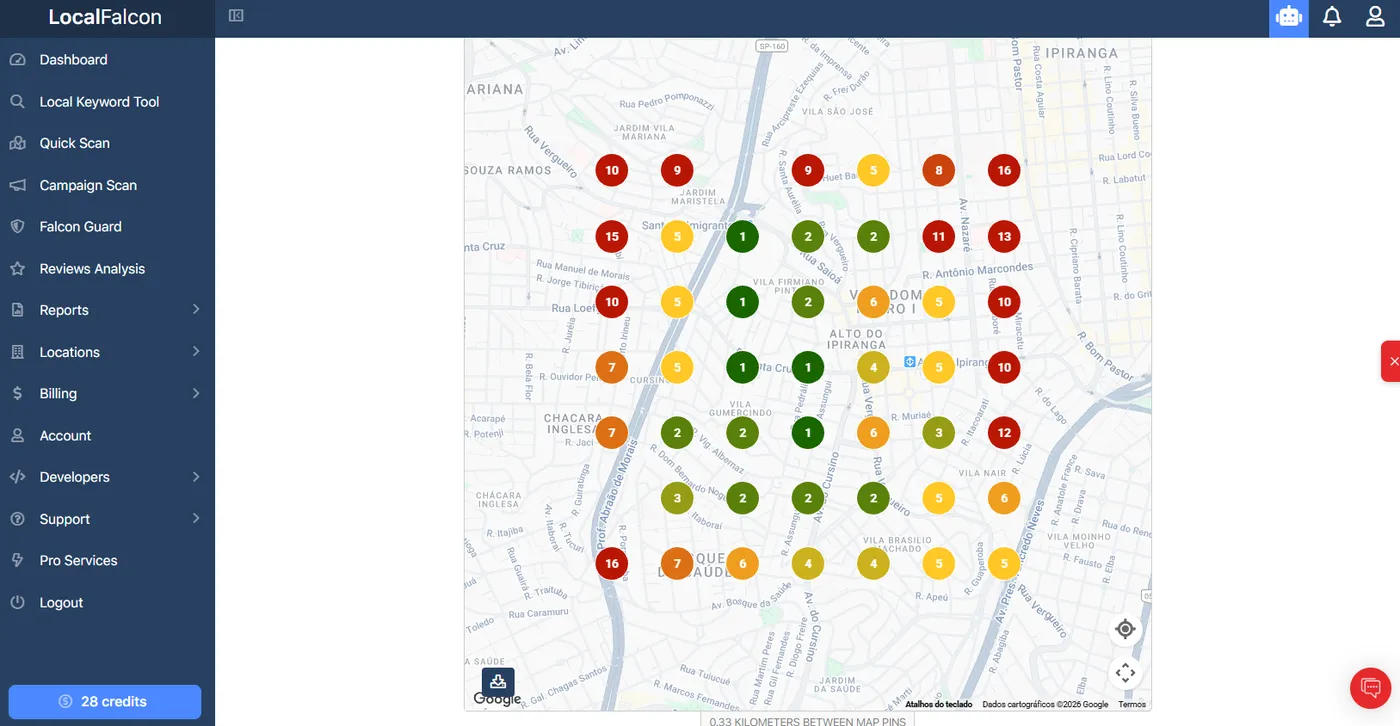
At the core of the grid, green pins at 1 and 2. Out at the edges, pins at 10, 13, 15, and 16. Strong in the center, weak on the rim of our own neighborhood.
The knowledge base of the tool describes that reading with two metrics. ARP: “ARP shows your average ranking across only the top 20 visible results in your scan”. ATRP: “ATRP shows your average ranking across all grid points, including positions outside the top 20”. And the way to use them: “Looking at both metrics side by side helps you understand where you’re strong and where you may need optimization”. 3
When the average of the visible points is good and the total average is bad, the diagnosis is ours: strong core, weak edge.
The market panel, with our numbers in it
The same scan returns a panel called Metric Insights, declared as “based on competitive analysis”. The SEO Genome numbers on that day: 4
| Metric | Us | Market reference |
|---|---|---|
| SoLV | 31.91 | leader at 63.83 |
| Visibility distance | 0.58 km | average of 2.88 km |
| Active competitors in the radius | 102 | 28 with SoLV above zero |
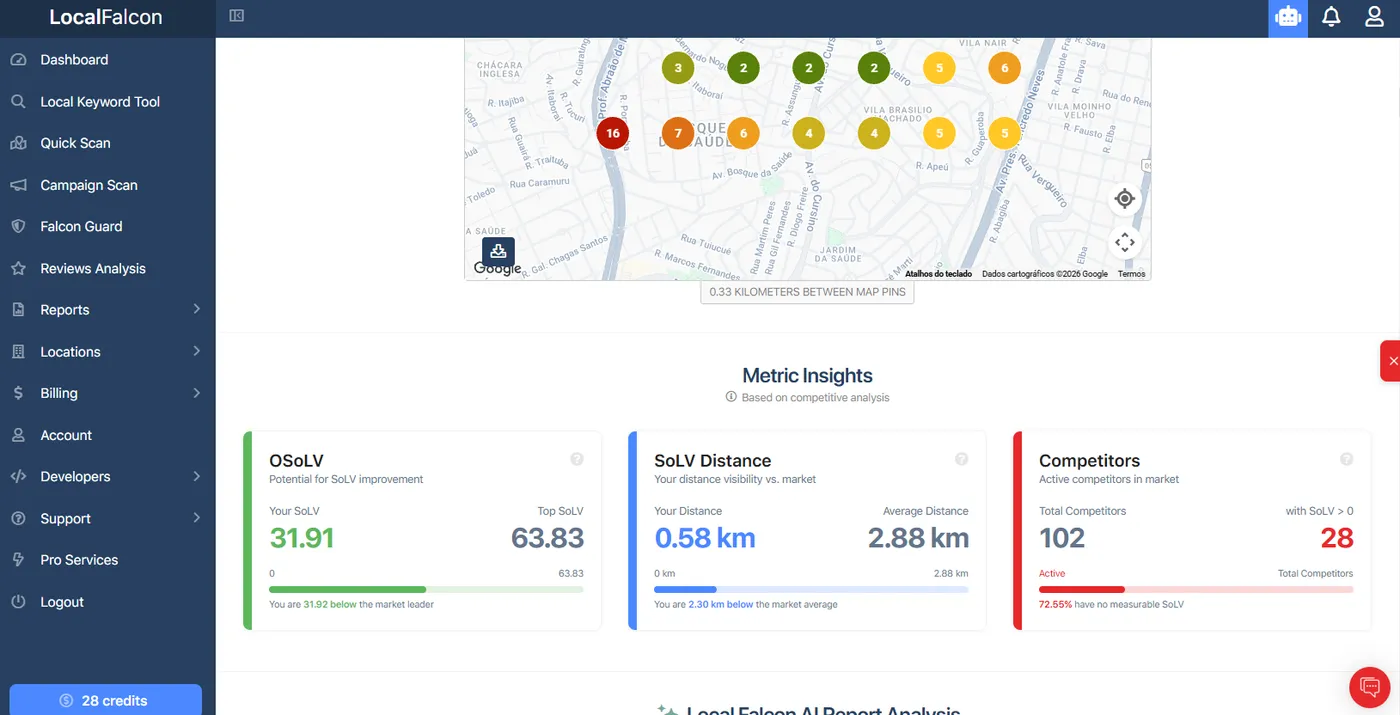
The screen sums it up with no mercy: “You are 31.92 below the market leader”. We sit at half the leader, and the panel says so to our face.
One figure from the same panel gives the fight its real size. Of the 102 active competitors, 72.55% have no measurable SoLV. The actual dispute runs among 28.
About the acronym SoLV, one necessary honesty. It stands for Share of Local Voice, and it is a trademark of Local Falcon. The knowledge base we consulted identifies the trademark and publishes no formal definition of the calculation. So I use the numbers the way the screen labels them, and I state no formula the source does not declare. 5
What the grid is not, and this part has to stick
A grid is not a Google report. No official panel of rank by street corner exists. The grid is a construction of the tool, which simulates searches from coordinates and records what came back. 1
Four practical consequences follow.
It is a sample of one moment. Two scans on the same day can disagree.
Real search is personalized. What each person sees varies by device, history, and context, and the simulation does not reproduce that.
The number serves to compare you against yourself over time. An absolute rank stated to one decimal place is model precision, and not a Google measurement.
And nobody buys rank. The official help declares: “There’s no way to request or pay for a better local ranking on Google”. 6 The scan shows where you stand. Climbing is a job of relevance and prominence, and that work is explained in the silo article on the three factors.
The tool has started scanning the AI answers
The platform selector of the scan shows Google Maps and Apple Maps. It also shows four more options, marked as beta: Google AI Overviews, Google Gemini, Google AI Mode, and ChatGPT. 7
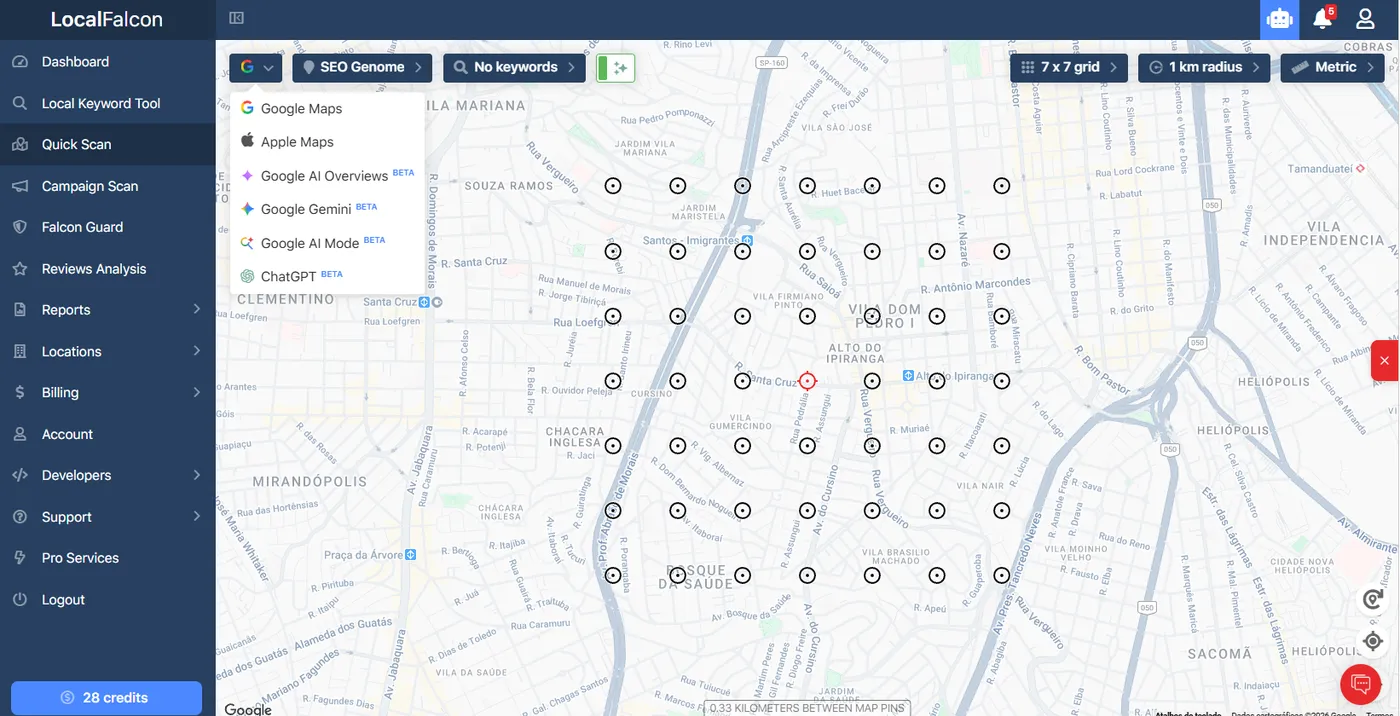
Which means the same grid logic is being pointed at AI answers. The feature is in beta, declared as beta, and we have published no reading of it yet. When we publish one, it will carry the rule of this article: data with a date, and the caveat ahead of the number.
What to do with your grid
Run one scan and keep the date. The first one is your baseline, and every later scan is read against it.
Look at the edge, not at the center. The center is almost always fine. The line where you disappear is the new information.
Repeat on a fixed interval. Monthly settles it for most businesses. What matters is the series, and not the snapshot.
And distrust any single-rank report. Whoever shows you one number alone is picking the corner that suits them.
Frequently asked questions
Does the scan show my real rank?
It shows what the simulation found at each point, at that moment. Real search is personalized per user, so treat it as an approximate portrait, and not as an exact measurement.
What counts as a good SoLV?
The tool publishes no formal definition of the calculation in the base we consulted. So the honest reading is relative: the leader inside your radius, and your own historical series. In our case, 31.91 against 63.83 for the leader. 4 5
Is a big grid better than a small grid?
It depends on the real reach of the business. The documentation declares grids from 3x3 to 21x21 and radii from 0.1 to 100 miles. A radius wider than your service area only adds red pins with no information in them. 8
Can I pay my way to a better rank?
No. The official Google help declares that there is no way to request or pay for a better local rank. 6
Notes and sources
- Local Falcon, knowledge base,
localfalcon.com/knowledge-base/, consulted on September 1, 2026. Description of how the grid scan works: one rank check per geographic point, for one keyword, on a grid centered on the business. - Scan of the SEO Genome Business Profile on September 1, 2026, for the term “agência de SEO” (SEO agency). Grid 7x7, radius of 1 km, 0.33 km between pins, Alto do Ipiranga, São Paulo, Brazil. Screenshots archived by SEO Genome on the same date.
- Local Falcon, knowledge base, article kb25 on ARP and ATRP. The three literal quotations are reproduced in the body. Consulted on September 1, 2026.
- Metric Insights panel of the scan in note 2. SoLV 31.91 against 63.83 for the leader; visibility distance of 0.58 km against an average of 2.88 km; 102 active competitors, 28 with SoLV above zero, 72.55% with no measurable SoLV. Labels and sentences quoted as displayed on screen.
- SoLV, Share of Local Voice, is a trademark of Local Falcon LLC. The knowledge base consulted on September 1, 2026 identifies the trademark and publishes no formal definition of the calculation. The caveat is SEO Genome’s.
- Google, Google Business Profile Help, “Improve your local ranking on Google”,
support.google.com/business/answer/7091, consulted on September 1, 2026. Literal quotation reproduced in the body. - Platform selector of the scan, captured on September 1, 2026: Google Maps, Apple Maps and, marked as beta, Google AI Overviews, Google Gemini, Google AI Mode, and ChatGPT.
- Local Falcon, knowledge base: grids from 3x3 to 21x21 and radii from 0.1 to 100 miles. Consulted on September 1, 2026.
Want to see SEO Genome more often on Google? Add it as a preferred source.
Let us look at what the machine understands about your company
A diagnostic conversation, with no slide deck. You bring your website address. We bring what Google and the AI assistants already know about it today.